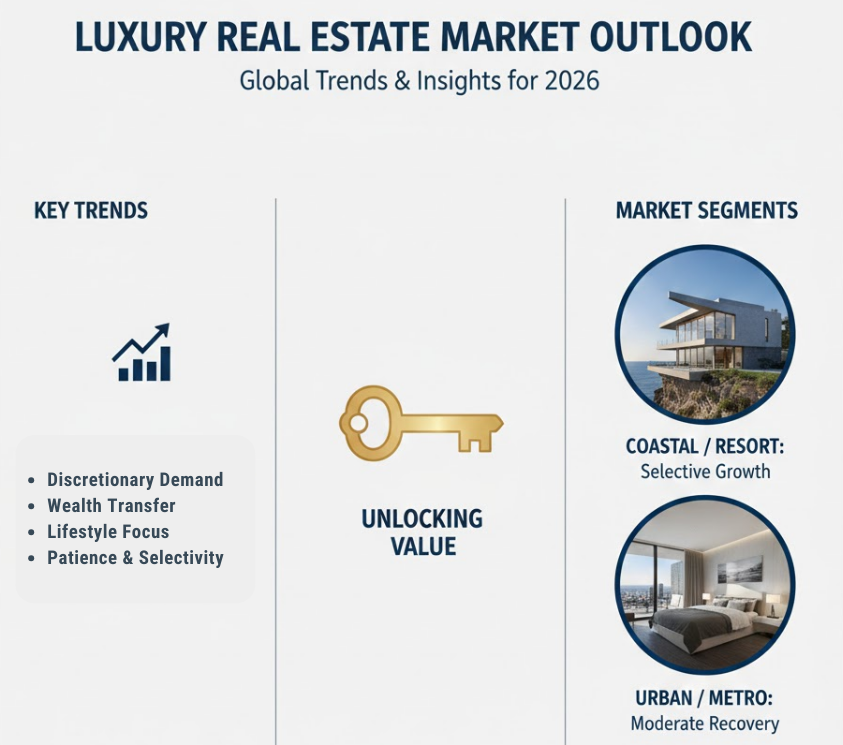
Luxury real estate has always behaved differently from the broader housing market. But in the current cycle, the Sunshine Coast luxury segment has not only slowed — it has slowed more visibly than the rest of the market.
That isn’t a contradiction of luxury’s resilience. It’s a function of how discretionary, confidence-based markets actually work.
To understand what’s happening now — and what comes next — we need to look at the data in three layers:
- a 10-year view of luxury performance,
- a direct comparison of 2025 vs 2024, and
- how this aligns with global luxury buyer behaviour identified in the Sotheby’s International Realty 2026 Luxury Outlook.
- A 10-Year View of Sunshine Coast Luxury ($2,000,000+)
Luxury on the Sunshine Coast is a thin market by nature. Annual activity is measured in dozens of sales, not hundreds — which makes shifts in confidence show up quickly and dramatically.
Sales Volume (Annual)
- 10-year average: ~26 luxury sales per year
- Peak year: 2021, with 59 sales
- Valley year: 2018, with 4 sales
This range alone illustrates how sensitive luxury is to timing and sentiment. When confidence surges, volume spikes. When confidence softens, buyers step back — even if prices don’t collapse.
Inventory (Average Monthly Listings)
- 10-year average: ~45 luxury listings
- Lowest inventory year: 2017, ~27 listings
- Highest inventory year: 2025, ~79 listings
Rising inventory in luxury doesn’t automatically force prices down. Instead, it increases choice, which slows decision-making and stretches timelines.
Pricing (Median of Monthly Medians)
- 10-year average median price: ~$2.55M
- Highest year: 2024, ~$2.83M
- Lowest year: 2022, ~$2.25M
Even during periods of low volume, luxury pricing has shown relative stability over time — reinforcing that pauses in activity are not the same as distress.
2025 vs 2024: Where the Shift Became Clear
From the full-market sales reports:
- Total sales: 562 in 2025 vs 633 in 2024 (≈ 11% decline)
- Median sale price: $835,000 vs $840,000 (essentially flat)
- Median days on market: 44.5 days vs 43 days
- Sale-to-list ratio: ~96.98% vs ~96.83%
Interpretation: the overall market softened modestly, but remained active and relatively stable.
Luxury Segment Comparison ($2,000,000+)
The luxury segment showed a sharper slowdown:
- Luxury sales: 23 in 2025 vs 31 in 2024 (≈ 26% decline)
- Average monthly inventory: ~79 listings vs ~76 listings
- Luxury median price: essentially flat year over year
This is the key distinction. Luxury slowed more in volume than the broader market — without a corresponding drop in price. That tells us this is a timing and selectivity issue, not a liquidity crisis.
Months of Inventory: Why This Is a Buyer-Leaning Luxury Market
Using annual sales pace and average inventory:
- 2024 luxury months of inventory: ~29 months
- 2025 luxury months of inventory: ~41 months
By any standard, this places luxury firmly in buyer-market territory.
However, this does not mean across-the-board discounting. It means:
- buyers have leverage,
- sellers must compete,
- and only well-positioned properties transact efficiently.
Why Luxury Slows Faster — and Feels It More
Luxury’s sharper slowdown is not a sign of weakness. It’s structural.
1) Luxury demand is discretionary
Many luxury purchases are second homes, lifestyle upgrades, or legacy assets. When uncertainty rises, these buyers pause first — not because they can’t buy, but because they don’t need to.
2) Luxury markets magnify change
A reduction of 8 sales in a year is barely visible in the full market. In luxury, it represents over a quarter of annual volume.
3) Inventory affects timing before price
When inventory increases, luxury buyers don’t rush. They compare. Choice extends timelines long before it forces pricing corrections.
What the Sotheby’s Luxury Outlook Confirms
The Sotheby’s 2026 Luxury Outlook reinforces why this cycle looks the way it does.
Key findings that align with Sunshine Coast data:
- Luxury buyers are less constrained by financing and geography
- Intergenerational wealth transfer is expanding the buyer pool
- Millennials are entering luxury earlier than previous generations
- Multigenerational living and legacy planning are growing motivators
- Buyers prioritize privacy, security, lifestyle, and long-term use, not short-term appreciation
In other words, luxury buyers don’t chase momentum. They wait for alignment.
What This Means for Buyers and Sellers Right Now
The Sunshine Coast luxury market is not weak — it is selective.
For buyers:
- This is a period of leverage, choice, and negotiation.
- Patience is rewarded, but decisiveness still matters when quality appears.
For sellers:
- Optimism alone no longer works.
- Pricing accuracy, preparation, and clarity are decisive advantages.
- Homes that feel rare, turnkey, and well-positioned still attract serious interest — even in a slow market.
The Takeaway
Luxury real estate doesn’t decline the way the broader market does.
It pauses — earlier, more visibly, and more quietly.
The data shows that today’s slowdown is driven by selectivity and confidence, not distress. Understanding that distinction is what allows buyers and sellers to navigate this cycle intelligently — rather than react emotionally.